Selhurst Derailment: When One Train Breaks the UK's Busiest Railway
A single derailed train inside Selhurst Depot brought Britain's busiest railway franchise to its knees, triggering an unprecedented "do not travel" alert. We investigate what actually happened and what it reveals about Britain's underfunded rail infrastructure.
It started like any Wednesday morning. Commuters across South East England boarded trains expecting the usual crowded, occasionally delayed journey into London. By 7:52 AM, Govia Thameslink Railway, the UK's largest rail franchise carrying 18% of all UK train journeys, issued an unprecedented warning: "Do not travel."
What followed showed how fragile Britain's railway infrastructure has become. A single derailed train inside a maintenance depot brought an entire region to its knees, affecting commuters, airport passengers, and the broader economy.
What Actually Happened at Selhurst?
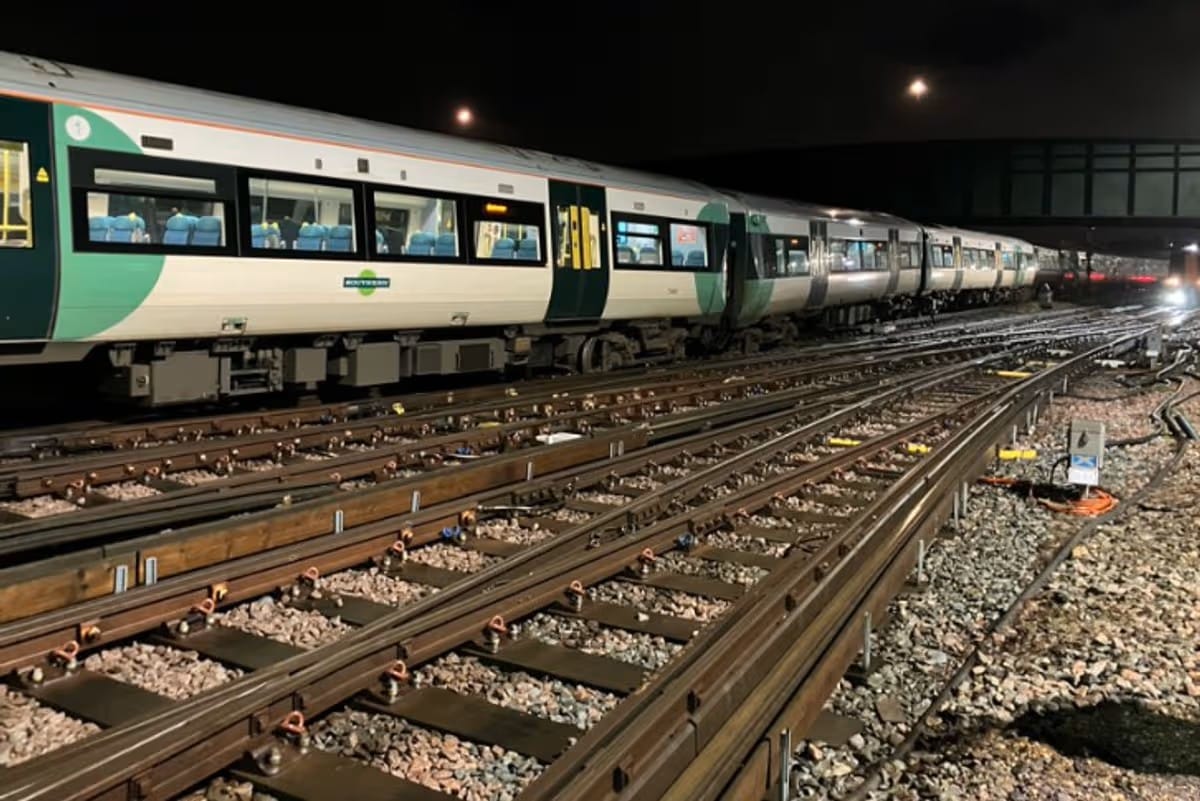
The incident occurred at Selhurst Depot, a critical maintenance facility in South Croydon strategically located on the Brighton Main Line. Built on the historic site of the Croydon Common Athletic Ground (where Crystal Palace F.C. played between 1920-1924), this depot services Southern's fleet of Class 171, 377, and 387 trains, the workhorses of London's suburban network.
According to Network Rail Kent and Sussex, a train derailed inside the depot itself, blocking the lines toward Norwood Junction and London Bridge. Images released by Network Rail show the train remained upright, a small mercy that meant no confirmed injuries, but the positioning was catastrophic. The derailed unit effectively sealed the depot, preventing other trains from leaving for morning service.
But this wasn't a single-point failure. Compounding the derailment was a separate signalling fault between London Blackfriars and Norwood Junction, a critical artery feeding into London Bridge. The combination created a perfect storm: no trains could exit the depot, and the alternative routes were crippled by signal failures.
The Scale of Disruption
To understand why one derailed train caused such chaos, you need to understand the network architecture. GTR is a behemoth running multiple distinct brands including Southern, Thameslink, and Gatwick Express.
When Selhurst Depot went down, the ripple effects were immediate and severe:
| Route | Impact |
|---|---|
| London Bridge to East Grinstead | Suspended |
| Orpington to Luton | Suspended |
| Brighton to Cambridge | Suspended |
| Bedford to Three Bridges | Suspended |
| Welwyn Garden City to Sevenoaks | Severely reduced |
| Rainham to Luton | Rainham to Dartford only |
Steve Lammin, Engineering Director at GTR, confirmed the operational nightmare: "There would be 134 trains out of position overnight, and drivers would have to begin Thursday's service in different locations."
The "do not travel" alert, issued at 7:52 AM and lifted around 10 AM, was unprecedented in its scope. Even after formal withdrawal, passengers were warned to expect delays of up to 60 minutes and significant service reductions throughout the day.
Gatwick Airport: The Economic Ripple
Beyond the commuter misery, the disruption had immediate economic consequences. Gatwick Airport, the UK's second-busiest airport, issued a statement warning passengers to "allow at least an extra 60 minutes" for journeys to ensure flight connections.
With Gatwick Express services severely reduced and Thameslink, the primary rail link to the airport, in chaos, thousands of travellers faced missed flights, expensive taxi alternatives, or frantic rebooking. For an airport handling over 40 million passengers annually, even a day of rail disruption creates measurable economic impact.
The Investigation: What Went Wrong?
Network Rail has launched a full investigation into the derailment. According to Lammin: "The train is now re-railed, but we need to clear the train from the track and then we need to look at the infrastructure and get that up and running safely overnight."
The Transport Salaried Staffs' Association (TSSA), representing railway workers, has called for a "full and clear account." General Secretary Maryam Eslamdoust emphasized: "Our union looks at this through the lens of safety on the railways, that is and will always be the number one priority."
But beyond the immediate investigation lies a deeper question: Why does Britain's railway still have such fragile single points of failure?
The Bigger Picture: A System Under Strain
The Selhurst incident doesn't exist in a vacuum. It comes against a backdrop of constrained infrastructure funding and mounting maintenance challenges.
According to the Office of Rail and Road's (ORR) 2024-2025 assessment, Network Rail is facing a £488 million funding gap for essential core renewals and maintenance. The RMT union reports that £1.2 billion has been cut from renewals expenditure in England and Wales for the current control period (CP7), with the Track Renewal Service (TRS) organisation abolished entirely.
The ORR's own assessment notes: "Constrained funding means that Network Rail will be spending less on renewals and more on life-extending repairs and maintenance in CP7 than in CP6."
Translation: Britain is patching up ageing infrastructure rather than replacing it, and hoping nothing critical fails.
GTR's Troubled History
This isn't the first time GTR has faced operational crisis. The franchise, operated by Govia, a joint venture between Go-Ahead Group and Keolis, has endured the 2018 timetable meltdown (described as the biggest rail disruption in modern UK history), the 2022-2024 strikes (GTR was among operators hit hardest by industrial action), and repeated reliability issues with punctuality consistently below national averages.
Notably, GTR's services are scheduled to return to public ownership on 31 May 2026, one of the first franchises to be renationalised under the new government's plans. Whether public operation will improve resilience remains to be seen, but the Selhurst incident highlights the operational challenges any operator will inherit.
Lessons from Selhurst
The Selhurst derailment offers several uncomfortable truths about UK rail infrastructure.
Depot Design Vulnerabilities
Selhurst's layout, a triangular site bordered by the Victoria Lines and London Bridge Lines, creates natural choke points. When one train blocks the depot exit, the entire fleet for multiple routes is affected. Modern depot design should incorporate redundant exit paths.
Cascading Failure Patterns
The coincidence of a derailment and a signalling fault on an alternative route suggests Britain's rail network has insufficient resilience. When primary routes fail, backup options are often compromised too.
Life-Extension Risks
Network Rail's shift toward "life-extending repairs" rather than full renewals is a false economy. Patching ageing infrastructure may save money in the short term, but it increases the probability of catastrophic failures exactly like this one.
Passenger Communication
The "do not travel" alert, while disruptive, was the right call. GTR and Network Rail were clear, early, and consistent in their messaging. When infrastructure fails, honest communication prevents worse outcomes.
What's Next?
As of publication, the immediate crisis has passed. The derailed train has been re-railed, the signalling fault resolved, and services are returning to normal, albeit with residual delays and displaced rolling stock.
But the questions raised by Selhurst will persist:
- Will the investigation identify systemic safety issues?
- Will Network Rail receive adequate funding for genuine renewals?
- Will GTR's transition to public ownership improve resilience?
- Will passengers see compensation for the disruption?
For the thousands who missed meetings, flights, and commitments on February 4th, these aren't abstract policy questions. They're about whether Britain's railway can be trusted to function.
The Bottom Line
One derailed train. One signalling fault. 18% of the UK's rail network crippled.
The Selhurst incident is a stark reminder that Britain's infrastructure isn't just creaking. It's one accident away from chaos. As the ICE's recent State of the Nation report warned, many assets require "more urgent attention." Selhurst proved how right they were.
For commuters, the message is clear: check before you travel, allow extra time, and hope the next derailment doesn't happen during your morning rush hour.
For policymakers, the message should be clearer still: patching up ageing infrastructure isn't a strategy. It's a gamble.
Sources
- BBC News - "Selhurst derailment causes severe disruption on train routes" (4 Feb 2026)
- Network Rail Kent & Sussex - Incident updates via X/Twitter
- Office of Rail and Road - Annual Assessment of Network Rail 2024-2025
- LBC - "'Do not travel' warning lifted after multiple incidents" (4 Feb 2026)
- Mirror Online - "Train derailment LIVE as Thameslink and Southern Rail in 'do not travel' alert" (4 Feb 2026)
- The Independent - "Biggest rail franchise issues 'do not travel' alert after 'multiple incidents'" (4 Feb 2026)
- RMT Union - "Rail cuts cost lives" campaign materials
Have you been affected by the Selhurst disruption? Share your experience in the comments or tag us on social media.



Comments ()