The Redway Experiment: The Hidden Failure of MK Secret Infrastructure
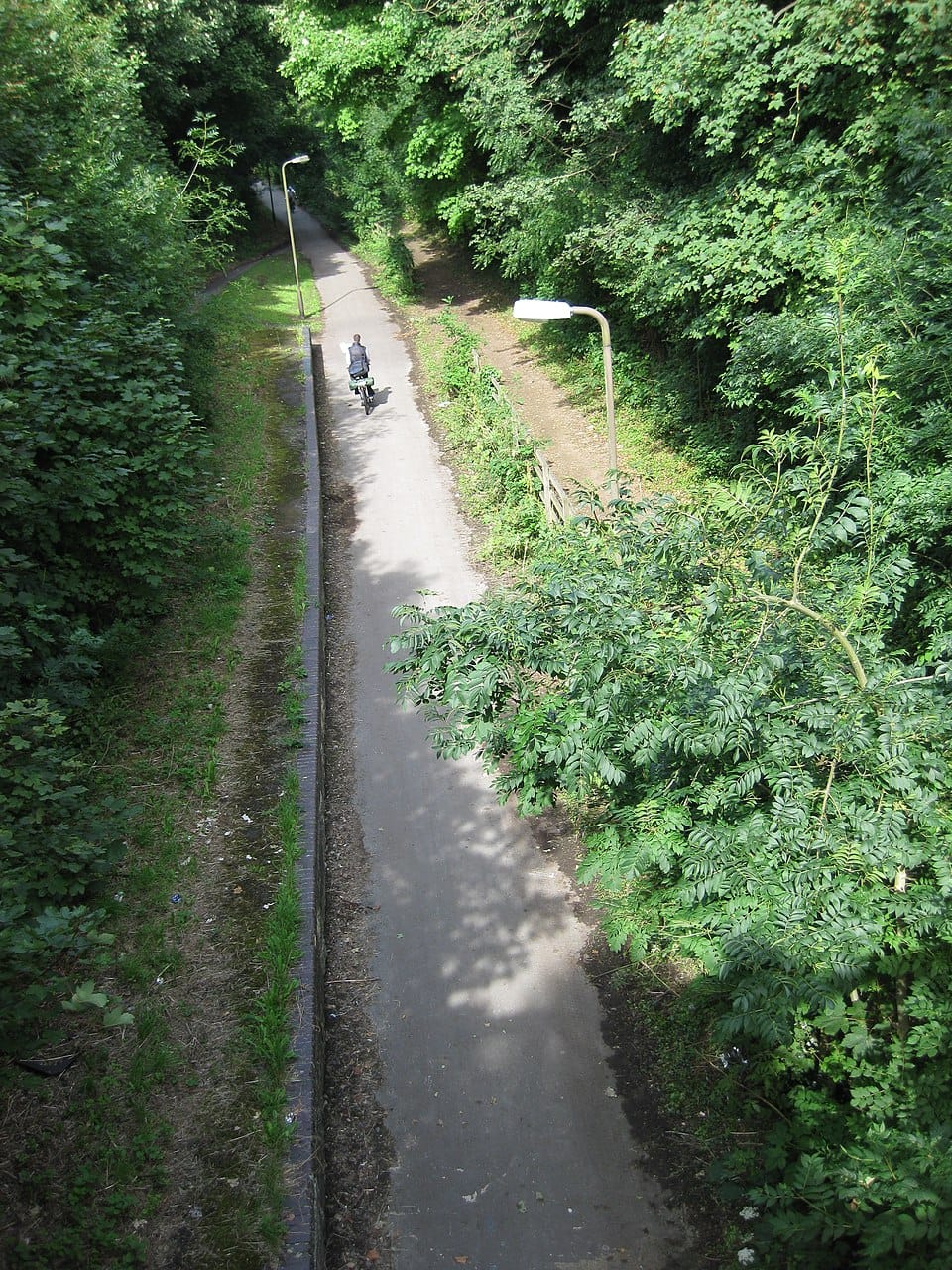
Hidden beneath Milton Keynes lies the Redway system, over 200 miles of red tarmac designed as a parallel city for pedestrians and cyclists. Fifty years later, it represents a fascinating paradox: a masterpiece of infrastructure that many residents avoid.
The Redway Paradox: Milton Keynes’ Failed Utopia?
Milton Keynes is often derided as a soulless grid of roundabouts and concrete, a city designed for cars at the expense of humans. However, this assessment ignores the most ambitious social engineering project in British history. Hidden beneath the embankments and tucked away from the roar of the H-roads lies the Redway system. It consists of over 200 miles of red tarmac, designed to be a parallel city where pedestrians and cyclists could move freely, entirely separated from the motor vehicle. This was the dream of the Milton Keynes Development Corporation (MKDC) in the 1970s. Yet, fifty years later, the Redways represent a fascinating paradox: a masterpiece of infrastructure that many residents avoid.

1. The Radburn Legacy and Social Engineering
The architectural DNA of the Redway system is not native to Buckinghamshire. Instead, it is an evolution of the Radburn Principle, a concept born in Radburn, New Jersey, in 1929. The idea was simple but revolutionary: separate cars and people entirely. In a Radburn-style development, houses face inwards towards quiet, green footpaths, while the noisy, dangerous cars are relegated to the rear.

In Milton Keynes, the MKDC pushed this logic to its absolute limit. They didn't just want a few paths; they wanted a total separation of grades. While cars sped along the grid roads at 60 or 70 miles per hour, pedestrians were supposed to glide through the estates on a dedicated network. The goal was safety and tranquillity. However, this separation created a secondary, "ghost city." In other UK towns like Skelmersdale, similar designs led to disaster. Without "eyes on the street" (a term coined by Jane Jacobs to describe the natural surveillance of active shopfronts and road-facing houses) these paths became magnets for anti-social behaviour. Milton Keynes avoided the worst of this through sheer scale and maintenance, but the feeling of isolation remains a core part of the Redway experience.
2. The Safety Paradox: The John Franklin Controversy
The most stinging critique of the Redways came not from architects, but from the very people they were designed for: cyclists. In 1999, cycling safety expert John Franklin published a seminal paper titled "Two Decades of the Redway Cycle Paths in Milton Keynes." His findings were a shock to the urban planning community.

Franklin argued that cycling on a Redway was potentially more dangerous than cycling on the grid roads. This seems counter-intuitive. How can a path with no cars be more dangerous than a dual carriageway? The answer lies in the junctions. When a Redway meets a local road, the "separation" logic breaks down. Visibility at these points is often abysmal, obscured by the very embankments designed to keep the noise out. Drivers, conditioned by the grid system to expect high-speed, uninterrupted travel, often fail to look for cyclists emerging from what appears to be a "secret" forest path.
Furthermore, the "stop-start" nature of these junctions destroys the momentum of a commuter. For a "vehicular cyclist" (someone who prioritises speed and efficiency) the Redways are a frustration. They are forced to give way at every minor estate road, whereas on the main grid roads, they have the same priority as a car. This has led to a split in the cycling community: families and leisure riders stick to the red tarmac, while the serious commuters stay on the road, much to the annoyance of motorists who wonder why the expensive paths are being ignored.
3. The Technical Tarmac Failures: Why Red?
The distinctive colour of the Redways was a deliberate choice to denote shared-use space. In the 1970s and 80s, this was achieved using a specific iron-oxide dye mixed into the tarmac. While it looked futuristic and helped with navigation, it created a technical nightmare for maintenance teams.

Iron oxide changes the chemical properties of the bitumen. Over time, it was discovered that the red tarmac was significantly more brittle than its black counterpart. It was more susceptible to "root ingress," where the roots of the thousands of trees planted by the MKDC would heave the surface upwards. This created what locals call the "Redway Ripple," a series of rhythmic, bone-shaking bumps that make cycling at speed almost impossible.
The maintenance of over 200 miles of this bespoke surface is a massive financial burden. As budgets have tightened, the quality of the Redways has diverged. Some sections remain smooth and pristine, while others have decayed into a patchwork of grey repairs and cracked red fragments. The very material chosen to define the system’s identity became the cause of its physical decline.
4. The 300 Underpasses: Acoustic and Social Isolation
Milton Keynes has more underpasses than almost any other European city. In a "forensic" sense, these are the most interesting parts of the network. Each one is a "Grade Separated Crossing," a feat of engineering designed to ensure that a human being never has to wait for a gap in traffic.

You can travel from Knotting Hill to Wolverton, a distance of several miles, without ever crossing a single road at grade. This is an incredible achievement of logistics. However, the underpasses create a unique social environment. They are echo chambers of concrete. They are often damp, poorly lit, and covered in graffiti. For a lone traveller at night, the underpass represents a moment of vulnerability. The very feature that keeps you safe from a car makes you feel unsafe from other people.
From an engineering perspective, these structures are fascinating. They must manage drainage, handle the weight of the grid roads above, and provide enough clearance for cyclists. Yet, as pieces of the urban fabric, they are often seen as "non-places," spaces to be moved through as quickly as possible rather than enjoyed.
5. The Logistics of the Unusual: Navigating the Maze
Navigating the Redways requires a different set of skills than navigating a standard city. In London or Manchester, you follow the street signs and the landmarks. In Milton Keynes, the landmarks are hidden. The Redway signs are small, often obscured by overgrown hedges, and use a numbering system that few people actually understand.

To travel the Redway system effectively, you have to embrace the "Logistics of the Unusual." You have to understand that the shortest distance between two points on a map is rarely a straight line on a Redway. The paths wind around housing estates, dip into valley parks, and spiral up and over bridges. It is a slow, serpentine way to move through a fast, linear city.
This creates a psychological barrier. To use the Redway is to opt out of the "efficient" city. It is a choice to take the long way home. For the "Forensic Explorer," this is the appeal. It is a way to see the "backside" of Milton Keynes (the hidden gardens, the forgotten play areas, and the secret corridors of nature that the drivers on the V6 or H8 never see).
6. Conclusion: Success or Failure?
Is the Redway system a failure? If the goal was to get everyone out of their cars and onto bikes, then yes. Milton Keynes remains one of the most car-dependent cities in the UK. The safety paradox and the maintenance issues have ensured that the grid road remains king.
However, if the goal was to create a unique urban experiment that offers a different way of living, then the Redways are a qualified success. They provide a green lung for the city. They offer a safe space for children to play and for elderly residents to walk without the constant threat of traffic. They are a monument to a time when we weren't afraid to try something completely different.
The Redway Paradox is that the system is both a masterpiece and a mess. It is a vision of the future that got stuck in the past. For those of us who live here, it is a constant reminder that urban planning is not just about moving objects from A to B; it is about the "Logistics of the Unusual," the unexpected ways that people interact with the concrete world around them.
Sources & References
- Franklin, J. (1999). Two decades of the Redway cycle paths in Milton Keynes. Traffic Engineering & Control. Link to Archive
- Milton Keynes Development Corporation (1970). The Plan for Milton Keynes. Link to MK Council Archives
- MK Cycle Forum. Historical Maintenance Records and Design Standards. Link to Forum
- National Infrastructure Commission. Review of Grade Separated Pedestrian Networks in New Towns. Link to NIC Report



Comments ()